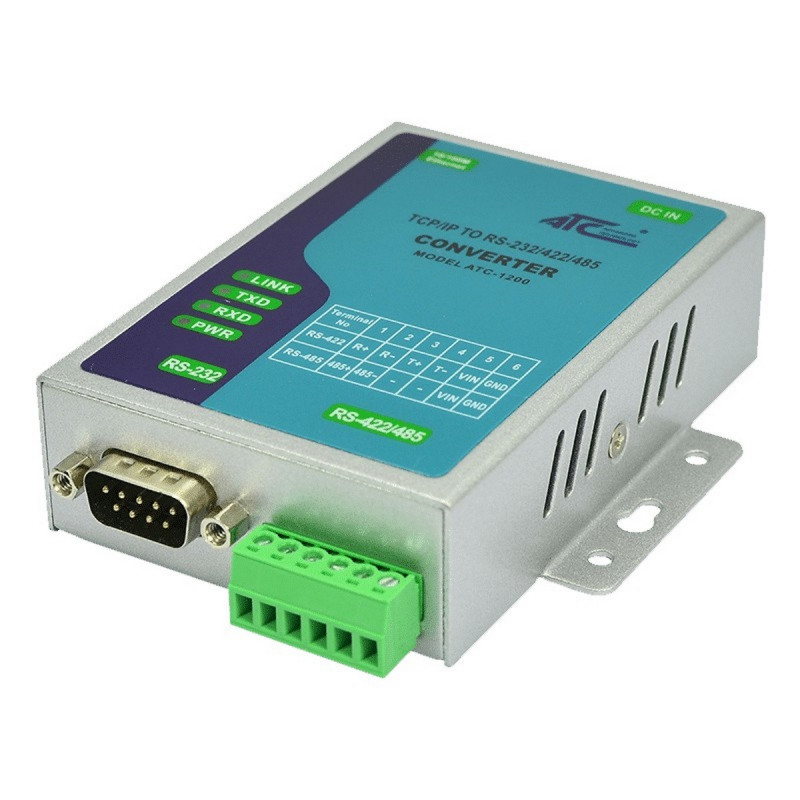


ATC-1200: 10/100 Ethernet to RS232/RS485/RS422 converter, with VCOM or VSP hardware virtual communication and TCP connection. Browser-based configuration. Up to 115,200 bits/s in RS232 and 921,600 bits/s in RS422/RS485. 9 V power supply included.
 Secure Payments
Pay securely with Credit Card, PayPal, Amazon Pay, Bank Transfer or PostePay
 Fast Shipping
We deliver throughout Europe and worldwide with UPS, DHL and DPD
 Easy 30-Day Returns
You have 30 days from delivery to return the product if you are not satisfied
The ATC-1200 is a device server that connects devices with RS232, RS485, or RS422 interfaces to a 10/100 Mbit/s Ethernet network. It allows you to manage serial devices remotely via virtual COM, direct TCP connection, or a bridge between two converters.
The serial interface and communication parameters, such as speed, parity, and stop bits, are configurable via a browser or Windows utility. It is suitable for integrating PLCs, CNCs, scales, barcode readers, inverters, time and attendance terminals, and supervision systems equipped with a compatible serial port.
An evolution of the ATC-1000, the ATC-1200 offers a compact and cost-effective solution for serial equipment networking, featuring a single-cycle-per-instruction AX11005 RISC processor, up to 100 MHz (100 MIPS) frequency, 512 KB of Flash memory, and 32 KB of SRAM. The platform integrates improved management and performance features for use in virtual COM mode.
In server mode , the converter receives the connection from the PC or other device; in client mode , it initiates the connection to the configured IP address. Internet access requires appropriate network configuration, especially when using routers and NAT.
Communication is bidirectional, with full duplex operation in RS232 and RS422. The RS232 interface supports RTS/CTS hardware flow control.
Device discovery and configuration functions are accessible via driver tools, the serial port, Telnet, and a web browser. SNMP management and RAW mode for direct network-to-serial communication are also available.
The supported baud rates are 1200, 2400, 4800, 9600, 19200, 38400, 57600, 115200, and 921600 bits/s . The 921600 bit/s rate is available on the RS422/RS485 interfaces; on RS232 the maximum is 115200 bits/s.
The serial format is configurable with 5, 6, 7 or 8 data bits , 1, 1.5 or 2 stop bits and even, odd or no parity.
The Ethernet port uses an RJ45 connector. The RS232 interface is available on a DB9 male (DTE) , while RS422/RS485 uses a 6-pin removable terminal block . The serial lines feature 600W surge protection; the Ethernet port integrates 1.5kV magnetic isolation.
Power can be supplied via terminals or via a 2.1 mm jack. The device accepts 9–24 V DC and is supplied with a 9 V DC power supply .
For use on a Wi-Fi network, an external Wi-Fi access point or bridge connected to the Ethernet port is required, not included.
| Characteristic | Specification |
|---|---|
| Serial interfaces | RS232, RS485 and RS422 selectable |
| RS232 speed | From 1,200 to 115,200 bit/s |
| RS422/RS485 speed | From 1,200 to 921,600 bit/s |
| Bits of data | 5, 6, 7 or 8 |
| Equality | Odd, even, or none |
| Stop bits | 1, 1.5 or 2 |
| Flow control | None, XON/XOFF, RTS/CTS |
| Serial connectors | DB9 male for RS232; 6-pin terminal block for RS422/RS485 |
| Serial line protection | 600 W for RS232/RS422/RS485 |
| Ethernet Network | 10/100 Mbit/s with auto-sensing, 8-pin RJ45 |
| Ethernet Magnetic Isolation | 1.5 kV integrated |
| Processor | RISC AX11005, 100 MHz (100 MIPS) |
| Memory | 512 KB Flash and 32 KB SRAM |
| LED indicators | LINK: Ethernet link and activity; TXD: Ethernet to serial data; RXD: Serial to Ethernet data; PWR: Power |
| Diet | 9–24 V DC, 1 A |
| Container | Metal, 1 mm thick |
| Assembly | DIN rail mount with optional adapter, not included |
| Dimensions without fins | 100 × 67 × 26 mm |
| Dimensions with fins | 100 × 86 × 26 mm |
| Weight | 0.5 kg |
| Operating temperature | From −25 to +70 °C |
| Storage temperature | From −40 to +85 °C |
| Relative humidity | 5–95%, non-condensing |
| Declared conformities | RoHS, CE, FCC |
Direct access via TCP/IP sockets allows integration with network applications on Windows 10, Windows 11, Windows Server, Linux, and macOS , without requiring a COM driver for the converter. Configuration is done via a web browser.
To create a virtual COM port on Windows, you can use VCOM, HW VSP, or similar software . HW VSP3 brings support back to Windows 10 and Windows Server 2016; for Windows 11 and other recent versions, you'll need to choose serial virtualization software that declares compatibility with your system. Virtual COM compatibility depends on the software and its installed driver.
The DIN rail mount, second converter for paired mode and external Wi-Fi devices are optional accessories not included.

Data sheet
ATC-1200: 10/100 Ethernet to RS232/RS485/RS422 converter, with VCOM or VSP hardware virtual communication and TCP connection. Browser-based configuration. Up to 115,200 bits/s in RS232 and 921,600 bits/s in RS422/RS485. 9 V power supply included.