
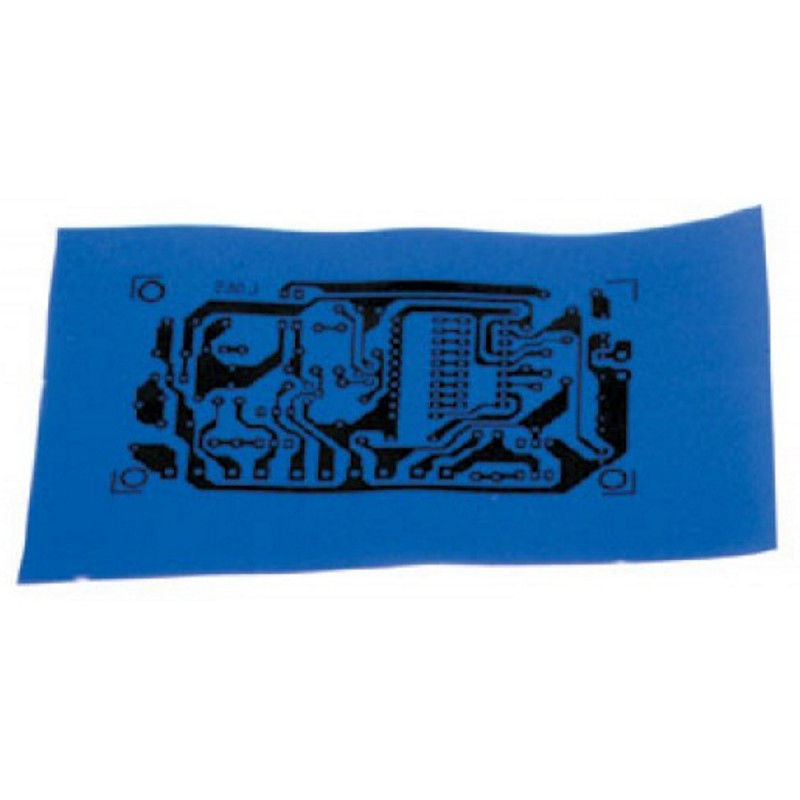


Special sheets of paper that allow you to create printed circuit boards without using a photocopying machine. No more photoengraving, thanks to a film onto which you simply photocopy or print the master. Pack of 50.
 Secure Payments
Pay safely with Credit Card, PayPal, Amazon Pay or Bank Transfer
 Fast Shipping
We ship across Europe and worldwide with UPS, DHL and DPD
 30-Day Easy Return
You have 30 days from delivery to return the product if you're not satisfied
Special sheets of paper that allow you to create printed circuit boards without using a photocopying machine. No more photoengraving, thanks to a film onto which you simply photocopy or print the master. Pack of 50.
The "PnP" (PRESS n PEEL) process for creating a printed circuit board eliminates the numerous steps required by traditional photo-etching. It uses a transparent film coated with a blue substance, which allows the printed circuit board tracks, previously printed on the sensitive side of the film using a photocopier or laser printer, to be transferred to the copper-plated surface of a board. Without further steps, you can proceed immediately to etching. Simply make a photocopy of the master on the sensitive surface of this film, or print the cs track on it with a laser printer. Then, place the printed side on the copper of the board and iron the shiny surface for a few minutes. Supplied complete with instructions. Single sheet size: 21.6 x 28.4 cm.
PHASES OF MANUFACTURING A PRINTED CIRCUIT BOARD
1 Draw the project and the related Master using any CAD program.
2 Print the mirror image of the Master on paper and photocopy (or print directly with a laser printer) onto the rough side of the PnP paper.
3 Cut out the sheet so you can reuse the rest of the paper for other circuits.
4 It is good to leave about a couple of centimetres of margin from the cs
5 Clean the copper base thoroughly with alcohol.
6 Place the PnP paper so that the toner is in contact with the copper
7 Pass the iron (170°-190°) over the paper to heat it evenly.
8 Let it cool and peel off the PnP paper from the copper base.
9 Dip the breadboard in the acid to corrode the excess copper.
10 The result after corrosion is the board with the desired copper tracks.
11 Clean the plate using nitro thinner.
12 Check for shorts due to uneven corrosion.
13 Once the printed circuit board is made, it's time to assemble all the components and thus assemble the complete board.

Data sheet
Special sheets of paper that allow you to create printed circuit boards without using a photocopying machine. No more photoengraving, thanks to a film onto which you simply photocopy or print the master. Pack of 50.